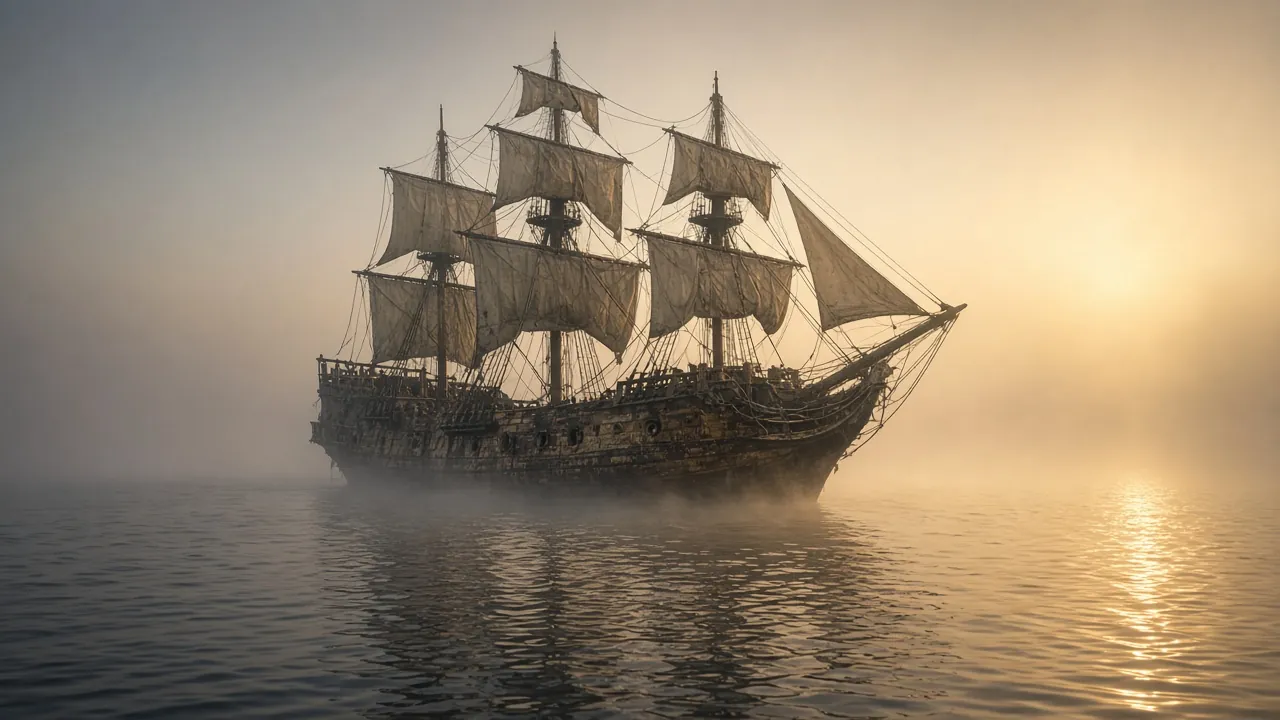
The Eerie Discovery: A Seaworthy Ship, an Absent Crew
The name Mary Celeste is synonymous with maritime mystery, a chilling tale of an abandoned ship found sailing inexplicably empty across the vast emptiness of the Atlantic Ocean. On December 4, 1872, the brigantine Dei Gratia, under the command of Captain David Morehouse, spotted a vessel behaving erratically approximately 400 nautical miles east of the Azores. As they drew closer, a boarding party led by First Mate Oliver Deveau made an astonishing discovery: the ship, identified as the Mary Celeste, was in a disheveled but seaworthy condition. Her sails were partially set, her cargo of industrial alcohol largely intact, and her stores well-provisioned. Yet, there was no sign of the ten souls who had been aboard – Captain Benjamin Spooner Briggs, his wife Sarah, their two-year-old daughter Sophia, and seven crew members. The last entry in the ship's log was dated 10 days prior. The Mary Celeste had become a ghost ship, instantly cementing her place as one of the most perplexing and enduring enigmas in nautical history.
The Ill-Fated Voyage and a Prior History of Mishaps
Originally christened the Amazon, the brigantine was built in Spencer's Island, Nova Scotia, in 1861. Her early years were plagued by a series of misfortunes: her first captain died shortly after taking command, she suffered multiple collisions, and a major grounding incident in 1867 off Cape Breton. After being salvaged and refitted, she was sold to American owners in 1868 and renamed Mary Celeste. She sailed uneventfully for a few years until her fateful voyage.
On November 7, 1872, the Mary Celeste departed from New York Harbor, bound for Genoa, Italy, with a cargo of 1,701 barrels of denatured industrial alcohol. Aboard were Captain Briggs, known for his piety and navigational skill, his family, and a seasoned crew. The vessel was considered sound, and the journey, though long, was routine for a ship of her kind.
The Findings of the Dei Gratia Boarding Party
When Deveau and his men boarded the Mary Celeste, they found peculiar inconsistencies. The ship's single lifeboat, a small yawl, was missing. The chronometer and sextant, vital navigational instruments, were also gone, as were the ship's papers (except for the captain's log). There was about 3.5 feet of water in the hold, not enough to threaten the ship's stability. While nine of the alcohol barrels were found empty, the majority of the cargo was present. The crew's personal belongings, including valuables, appeared undisturbed, ruling out piracy as an immediate explanation. A sword was found, but it was sheathed and not indicative of a struggle. The overriding impression was one of a hasty, but not panicked, abandonment.
The Gibraltar Inquiry and the Birth of a Legend
Following her discovery, the Mary Celeste was sailed to Gibraltar by a prize crew from the Dei Gratia. An official inquiry was launched, spearheaded by Frederick Solly-Flood, the Attorney General of Gibraltar. Solly-Flood was deeply suspicious, initially entertaining theories of mutiny, piracy by the Dei Gratia crew, or insurance fraud. However, extensive examination of the vessel, interrogation of witnesses, and a lack of any conclusive evidence of foul play ultimately led the court to dismiss these dramatic possibilities.
The inquiry's final report, issued on February 25, 1873, concluded that the crew had abandoned the ship, likely in a moment of panic, but offered no definitive reason. The unsatisfying conclusion of the official investigation, coupled with the inherent mystery of the empty ship, ignited public imagination. The Mary Celeste quickly became a sensation, inspiring countless speculative stories, many of which sensationalized the facts and contributed to the "ghost ship" folklore. Arthur Conan Doyle's fictionalized account, "J. Habakuk Jephson's Statement" (1884), further cemented the ship's legendary status, even popularizing the erroneous "Marie Celeste" spelling.
Enduring Theories: What Really Happened to the Crew?
Over the past 150 years, numerous theories have been proposed to explain the Mary Celeste's baffling abandonment. While none have achieved universal acceptance, some are more plausible than others.
1. Alcohol Fumes, Explosion, and Abandonment
This theory, which has gained significant traction, posits that fumes from the industrial alcohol cargo played a crucial role. The Mary Celeste's cargo of crude alcohol was shipped in raw red oak barrels, which were inherently porous. It is believed that leakage from these barrels could have produced a build-up of highly flammable alcohol vapor in the ship's hold.
The theory suggests that Captain Briggs, perhaps detecting unusual smells or even hearing a muffled explosion, feared an imminent, catastrophic blast. In a state of extreme caution, he might have ordered the ship to be temporarily abandoned. The crew would have boarded the yawl, which was then tethered to the brigantine with a long line. They would have waited at a safe distance for the vapor to dissipate. This explains the missing lifeboat, the haste (no personal belongings taken), and the relatively calm state of the ship when found. The nine empty barrels support the idea of leakage and subsequent evaporation or dispersal of gas.
The crucial missing piece for this theory is why they never returned. A sudden change in weather, a snapped towline, or some unforeseen event could have separated the yawl from the Mary Celeste, leaving the crew adrift and the ship to sail on. The Smithsonian Magazine notes that in 1884, the Mary Celeste was deliberately wrecked off the coast of Haiti in an insurance fraud scheme by her then-captain, which illustrates the ship's later unfortunate history but doesn't shed light on the 1872 event directly.
2. Waterspout or Rogue Wave
Another popular theory suggests that a powerful waterspout (a tornado over water) or an exceptionally large rogue wave could have struck the Mary Celeste. Such an event could have swept the crew overboard or damaged the ship severely enough to prompt an abandonment. The presence of water in the hold could be interpreted as evidence of such a disturbance. However, accounts from the Dei Gratia crew described the Mary Celeste as relatively undisturbed, with sails partially set, which doesn't entirely fit with the chaos a waterspout or rogue wave might inflict. also, the missing navigational instruments still require explanation.
3. Mutiny or Piracy
As initially suspected by Solly-Flood, mutiny or piracy were early considerations. However, the lack of any signs of struggle, blood, or theft of valuables onboard the Mary Celeste rendered these theories largely untenable. The brigantine was found with valuable cargo and personal items intact, making piracy highly unlikely. Similarly, a mutiny that resulted in the complete and bloodless disappearance of all crew and the captain's family, with the ship otherwise unharmed, strains credulity.
4. The Forensic Re-Evaluation: The Camp Family's "Hydrodynamic Trap"
A compelling recent re-evaluation, notably by the Camp family in early 2026, presents a multi-faceted explanation that integrates forensic science, naval architecture, and human psychology. Their "Hydrodynamic Trap" thesis suggests Captain Briggs did not abandon the ship in a panic, but rather executed a controlled "Arms-Length Strategy." Fearing an explosion from alcohol fumes, he kept the Mary Celeste under partial sail to maintain slow forward momentum, preventing it from drifting backward and crushing the lifeboat (yawl) to which the crew was tethered.
According to this analysis, the tragic separation occurred due to a combination of factors:
- Porous Barrels & Vapor Leakage: Confirmed by analysis, red oak barrels leaked significantly.
- Pressure Ignition: An event (e.g., spark, static discharge) caused a "cold" pressure wave igniting fumes, possibly blowing off hatches without a full fire. This would have been terrifying but not immediately destructive.
- Compromised Pumps & Chronometer Error: Prior coal cargo likely fouled the pumps, and oceanographic drift modelling suggests Briggs was 100+ miles off his perceived position, believing land was closer than it was.
This synthesis explains the missing yawl, the lack of violence, the undisturbed personal belongings, the water in the hold, and even the "stove-in" railing as a sequence of logical, albeit tragic, events driven by rational decisions made under extreme pressure, leading to an irreversible accident.
Conclusion: A Mystery Endures, Yet Narrows
While the Mary Celeste continues to hold its place in the pantheon of unexplained disappearances, modern research and re-evaluations offer increasingly sophisticated and plausible explanations that move beyond pure speculation. The "ghost ship" narrative, though captivating, is slowly giving way to a more scientific understanding of a complex maritime tragedy.
The story of the Mary Celeste serves as a powerful reminder of the inherent dangers of seafaring, the fallibility of human judgment under stress, and the capacity for the ocean to erase all traces of those who challenge its might. Even with advanced forensic techniques and historical analysis, the exact moment-by-moment fate of Captain Briggs, his family, and his crew remains elusive, ensuring that the Mary Celeste will continue to drift through our collective imagination, a silent proof of the mysteries that lie beneath the waves.
Sources and further reading
- Smithsonian Magazine: Abandoned Ship: The Mary Celeste: the documented facts of the 1872 discovery.
- Royal Museums Greenwich collections: maritime records and historical context.