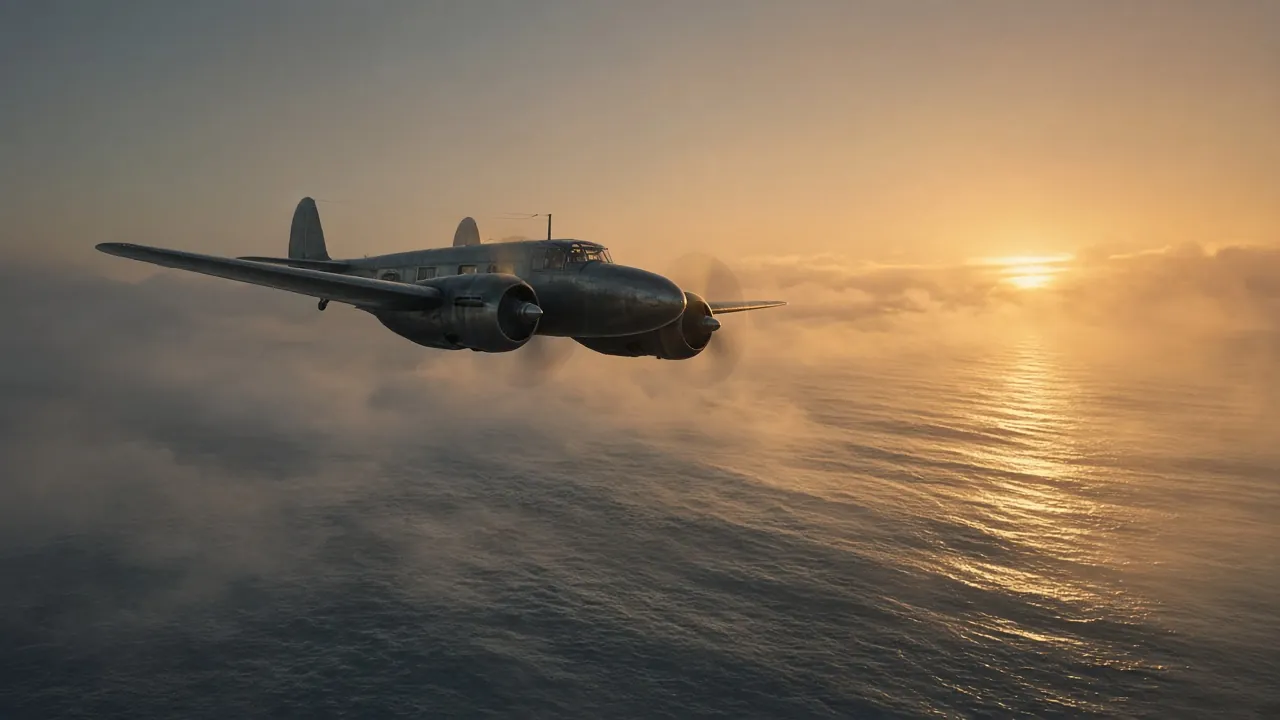
The Daring Dream: Amelia Earhart's Quest for Global Circumnavigation
Amelia Earhart, an icon of courage, determination, and pioneering spirit, etched her name into the annals of history not only for her extraordinary aerial achievements but also for her enigmatic disappearance. In 1937, at the peak of her fame, Earhart embarked on an audacious attempt to circumnavigate the globe at its widest part, a dangerous journey that would ultimately claim her and her navigator, Fred Noonan. Her vanishing over the vast expanse of the Pacific Ocean sparked one of the most extensive search and rescue operations in history and continues to fuel speculation and fascination decades later. This exploration looks at Earhart's ambitious final flight, the circumstances surrounding her disappearance, the myriad theories that have emerged, and her enduring legacy as a symbol of human aspiration.
A Life Defined by Flight: Breaking Barriers in the Sky
Born in Atchison, Kansas, in 1897, Amelia Mary Earhart developed an early fascination with aviation. She transcended societal expectations for women of her era, dedicating her life to flying and advocating for women's rights in typically male-dominated fields. Her list of accomplishments was impressive: in 1928, she became the first woman to fly as a passenger across the Atlantic; in 1932, she achieved solo transatlantic flight, an unprecedented feat for a woman, earning her the Distinguished Flying Cross. Earhart leveraged her celebrity to promote air travel, write best-selling books, and co-found the Ninety-Nines, an organisation supporting female pilots. Her charisma and fearlessness made her a global sensation, paving the way for her most ambitious endeavor: a flight around the world.
The Final Journey: A World in Two Attempts
Earhart's first attempt at global circumnavigation began in March 1937, flying west from Oakland, California. This attempt was cut short in Hawaii due to a landing accident that severely damaged her Lockheed Electra 10E. Undeterred, she quickly secured funding and a new plane, planning a second attempt that would begin from the east, taking advantage of prevailing winds.
On June 1, 1937, Earhart and her navigator Fred Noonan departed from Miami, Florida, for the eastbound circumnavigation. Their modified Lockheed Electra 10E, dubbed the "flying laboratory," was equipped with additional fuel tanks to cover the vast distances. For weeks, they successfully navigated across the Atlantic, Africa, India, and Southeast Asia, meticulously logging thousands of miles. By June 29, they had reached Lae, New Guinea, having covered approximately 22,000 miles of their 29,000-mile journey. What remained was the most perilous leg: a 7,000-mile stretch across the Pacific Ocean, with the tiny Howland Island as their next crucial refueling stop.
The Fateful Leg: Navigating the Pacific to Howland Island
The segment from Lae to Howland Island, a minuscule speck of land just two miles long, was arguably the most challenging. It required precise celestial navigation from Noonan and immaculate flying from Earhart. On July 2, 1937, at approximately 00:00 GMT, they departed Lae. Their destination was an uninhabited coral atoll about 2,556 miles away, barely visible from the air.
The US Coast Guard cutter Itasca was stationed off Howland Island, ready to provide radio navigation and support. However, communication proved problematic. Static, frequency issues, and a lack of clear radio beacons hampered efforts to establish reliable two-way contact. As the Electra approached Howland Island in the early morning hours of July 3 (local time), Earhart’s radio transmissions became increasingly desperate, reporting low fuel and an inability to locate the island. "We are on the line 157 337. We are running north and south," she transmitted, indicating they were flying parallel to Howland Island's navigational line, but could not pinpoint its exact location. Her final, garbled transmissions faded, leaving a silence that would reverberate through history.
The Search and the Enduring Theories
Upon the loss of contact, an immediate and unprecedented search operation was launched. The US Navy and Coast Guard deployed ships and aircraft, scouring thousands of square miles of ocean. President Roosevelt personally authorized immense resources for the search, which continued for weeks. Despite the massive effort, no trace of the Electra, Earhart, or Noonan was ever found. On July 19, 1937, the search was officially called off, and Amelia Earhart was declared legally dead in 1939.
The lack of any wreckage or remains gave rise to numerous theories, each attempting to explain the vanishing act:
1. The Crash and Sink Theory (Most Widely Accepted)
The most prosaic, yet scientifically supported, theory is that Earhart and Noonan simply ran out of fuel and crashed into the Pacific Ocean. Given the immense distance, the challenging navigation to a tiny island, and the documented radio communication issues, this is highly plausible. The Electra was not designed for water landings and would have sunk quickly, leaving little to no trace. Deep-sea exploration efforts, notably by The International Group for Historic Aircraft Recovery (TIGHAR), have focused on underwater searches in the vicinity of Howland Island, often utilising sonar and remotely operated vehicles (ROVs). TIGHAR's research has explored the possibility of a "post-crash survival theory," suggesting that Earhart and Noonan might have made an emergency landing on Gardner Island (now Nikumaroro), an uninhabited atoll, and survived for a period before succumbing. This theory is supported by potential radio distress calls heard in the days following the disappearance and the discovery of artifacts (like shoe fragments and bone fragments) on Nikumaroro that could be linked to the aviators. However, no conclusive evidence has yet been found to unequivocally prove human presence there or definitively link the artifacts to Earhart or Noonan.
2. The Japanese Capture Theory (The Saipan Theory)
This highly sensationalized theory posits that Earhart and Noonan survived a crash landing, only to be captured by Japanese forces in the Marshall Islands, then under Japanese mandate. The theory claims they were either executed or held captive as spies, with some variations suggesting they died in prison or were used for propaganda. Proponents often point to alleged sightings of the pair in Japanese custody, or claims of a cover-up. However, there has never been any credible, verifiable evidence from Japanese records or witnesses to support this theory. Most historians and researchers dismiss it as unsubstantiated rumor, often fueled by Cold War anxieties and anti-Japanese sentiment that emerged years after the disappearance.
3. The Japanese Spy Mission Theory
A more extreme offshoot suggests Earhart and Noonan were on a secret spy mission for the US government, gathering intelligence on Japanese military installations in the Pacific. Their flight path brought them dangerously close to Japanese-held territories, leading some to believe their disappearance was a result of their covert activities. This theory lacks substantial proof and is largely considered improbable, as the US government would have been unlikely to risk its most famous female aviator on such a sensitive mission without more plausible deniability.
4. Return to the US Mainland (and Assumed Identity)
Though less common, some theories suggest that Earhart and Noonan secretly returned to the US mainland, assumed new identities, and lived out their lives in anonymity. This idea often stems from the public's desire for a happier ending to the story but lacks any concrete evidence and is generally dismissed by serious researchers.
Legacy of a Pioneer
Despite the enduring mystery surrounding her fate, Amelia Earhart's legacy shines brightly. She shattered gender barriers in aviation, demonstrating that women were capable of extraordinary feats of engineering, courage, and athleticism. Her trailblazing spirit inspired countless women to pursue careers in science, aviation, and other traditionally male-dominated fields.
The ongoing fascination with her disappearance ensures her place in public consciousness, keeping her story alive for new generations. Projects like TIGHAR's expeditions, while yet to yield conclusive proof, continue to symbolize humanity's relentless quest for answers and our enduring admiration for those who dare to push the boundaries of what is possible. Amelia Earhart remains a potent symbol of adventure, a proof of the human desire for exploration, and an eternal reminder of the vast, unconquered frontiers that still exist, both in the physical world and in the realm of human knowledge. Her story, though tinged with tragedy, continues to inspire us to look to the skies and dream beyond the horizon.
Sources and further reading
- Smithsonian National Air and Space Museum: Amelia Earhart: Earhart's life and final flight.
- Purdue University Libraries: Amelia Earhart papers: the archive of Earhart's papers.